
Newton Wood Flooring has worked on wood floors for more than 20 years, and much of our work is helping homeowners replace carpet with hardwood in Newton, MA, serving surrounding cities including Watertown, Brookline, Needham, Wellesley and Waltham. Sometimes that means a brand new floor. In many older houses it means pulling up the carpet and finding oak that only needs refinishing.
Either way, the first step is to look underneath. What is under the carpet decides the job, the price and the schedule, so we lift a corner before quoting rather than guessing from the surface.
Carpet replacement is also an easy project to do one room at a time. A bedroom or a living room can be done now and the rest of the floor later, and we plan transitions so the house looks consistent at every stage.
What Is Under Your Carpet
Oak Floors Worth Refinishing
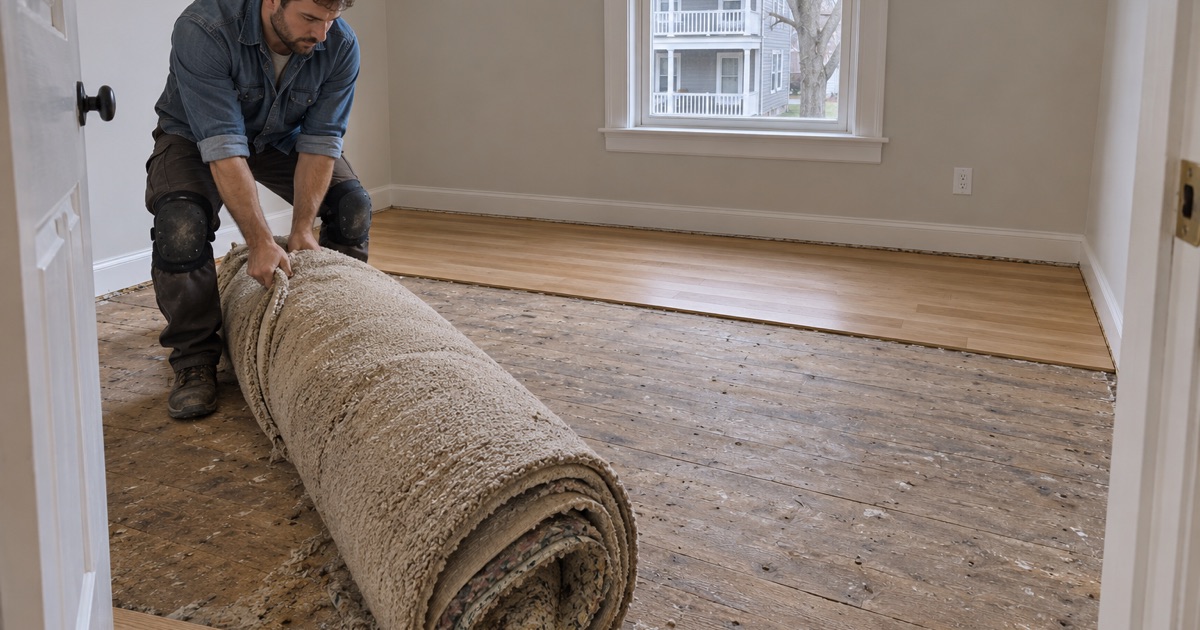
In a large share of older houses, wall-to-wall carpet was laid straight over existing oak floors. Those floors are often in good condition, because the carpet shielded them from foot traffic and sun fade, and many need only one full sanding and finish to look new.
We measure how much wood is left above the tongue and check for damage such as pet urine stains, water stains or boards cut for heating ducts. Patches are woven in before sanding, so the finished floor looks continuous.
Carpet Pad, Staples and Tack Strip
Taking carpet up leaves its own work behind. Old carpet pad often breaks down and sticks to the wood, staples are scattered across the field, and tack strip is nailed along every wall.
We scrape the pad, pull every staple and strip, and fill or patch the holes. That prep matters most at the edges, where tack-strip holes are the first thing you notice in a refinished room if they are not dealt with properly.
Old Tile and Black Mastic
In some houses, the carpet covers old resilient floor tile, often with black mastic adhesive beneath it. Some older tiles and mastics contain asbestos, which is why we never sand, scrape or grind them.
We identify the material and stop work until the right trade has tested and handled it. Once that is done, we decide whether the new hardwood goes over the area or the old layers have to come up first.
Plywood Subfloor With Nothing Above It
In newer houses and additions, carpet was often laid directly over plywood or similar subfloor. Here the answer is a new floor, and the subfloor is checked for flatness, loose spots and squeaks before installation. Loose sheathing is refastened to the joists and high or low spots are corrected, because a new hardwood floor will reveal every dip in the subfloor beneath it.
Installing New Hardwood Where Carpet Was
Solid or Engineered
Over a wood subfloor on an upper level, solid hardwood is usually the right choice and can be sanded many times over its life. In a basement or over concrete, we measure moisture first, and the answer is usually engineered flooring with a suitable underlayment.
We also talk through prefinished and site-finished options. Site-finished floors can be stained to match an adjoining room, which often matters when only part of a house is being changed.
Heights, Transitions and Doors
Carpet and pad together are often thicker or thinner than the hardwood replacing them, so the new floor may sit at a different height from the rooms next to it. We plan reducers and thresholds at every doorway and check door clearances before starting.
Where the new floor meets an existing wood floor of the same species, we can weave the two together instead of using a threshold, so the change reads as one continuous floor.
Baseboards and Quarter Round
Carpet usually tucks under baseboards with a gap at the bottom. Hardwood needs an expansion gap at the walls, covered by the baseboard or by quarter round. We decide whether to reset the existing baseboards or add quarter round based on the gap left behind and the look of the room.
Carpeted Stairs to Wood
Refinishing the Existing Treads
Stair carpet sometimes hides finished hardwood treads that just need staples and tack strip removed and a fresh finish. When it does, we refinish them tread by tread so they match the new floors.
Stair carpet is often held by more staples than floor carpet, especially at each nosing. Every one is pulled and the holes filled, and any loose tread is refastened before sanding so the staircase is quiet as well as clean.
New Treads and Risers Over Rough Steps
More often, carpeted stairs are built from rough treads never meant to be seen. We fit new hardwood stair treads and risers over them, cut to each step, with a proper stair nosing, then finish them to match the floor.
Because older staircases are rarely square, each tread is scribed to its own step rather than cut to a standard length. The result looks like a staircase built in hardwood from the start rather than a cover laid over one.
Living With Hardwood Instead of Carpet
Noise, Rugs and Condominium Rules
Hardwood carries footsteps more than carpet, especially to rooms below. Area rugs in living spaces help, and many condominium associations require an acoustic underlayment under hard floors. We ask to see the actual rules before ordering, so the new floor complies from the start.
Hardwood is also easier to keep clean than carpet, and it does not hold dust and pet hair the same way. Felt pads under furniture legs and a doormat at each entry do most of the work of keeping the new finish looking new.
One Room or a Whole Floor
The steps are the same for one room or a whole level. What changes is how transitions are handled and how the work is scheduled around the household, and we plan both before the carpet comes up.
If you are replacing carpet in stages, we note the species, width, stain and finish used in the first rooms. When the next rooms are done, they can be matched to the first without guesswork.
- 20+ Years on Wood Floors
- Stairs Quoted Tread by Tread
- Lead Checks Before Sanding