
Newton Wood Flooring has worked on wood floors for more than 20 years and installs herringbone wood floors in Newton, MA, serving surrounding cities including Watertown, Brookline, Needham, Wellesley and Waltham. We lay herringbone and chevron patterns, add borders and inlays, install wide plank floors in white oak and hickory, and refinish older parquet and pattern floors already in place.
Pattern and wide plank floors are less forgiving than straight strip floors. A pattern that starts a few millimeters off grows into a visible wander across a room, and wide boards move more with seasonal humidity. Careful layout, a flat subfloor and proper acclimation are what make these floors look right for years.
We plan each floor around the room itself: where you enter, where the light falls and where the furniture will sit. That plan comes before any board is cut.
Herringbone and Chevron Explained
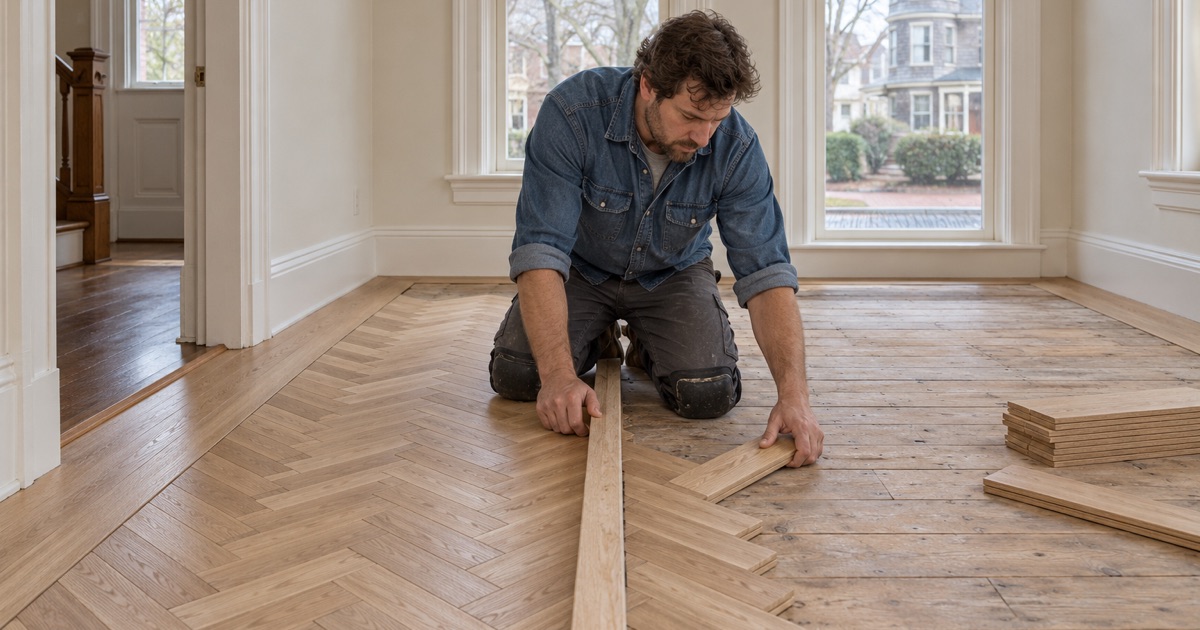
Herringbone Patterns
Herringbone uses rectangular boards with square-cut ends laid in a staggered zigzag, so the end of one board meets the side of the next. The pattern has been used in fine floors for centuries and suits both traditional and modern interiors.
Board size changes the effect. Short, narrow boards give a tight, busy pattern, while longer and wider boards make a larger, calmer zigzag that suits big rooms.
Chevron Patterns
Chevron uses boards cut at an angle on each end, so they meet in a clean point and form a continuous V across the room. It reads as more formal and more directional than herringbone.
Because every joint is an angled cut, chevron needs precise manufacturing or cutting. Most chevron floors are made from boards milled for the pattern rather than cut on site.
Parquet and Older Pattern Floors
Many older houses have parquet or herringbone floors made from small wood blocks. These floors can often be refinished, though loose blocks need regluing and the pattern has to be sanded with care because the grain runs in many directions at once.
We run the drum sander at an angle to the blocks rather than along any one of them, then finish with an orbital sander to take out the cross-grain scratches. Before sanding, we check how much wood the blocks have left, since thin parquet tolerates very little.
Planning a Pattern Floor
Layout and the Center Line
Every herringbone or chevron floor starts with a carefully set center line, usually aligned with the main view into the room, a fireplace or a long wall. Small errors at the start compound across the floor, so the layout is checked and rechecked before installation begins. We dry-lay sections to confirm how the pattern meets walls, doorways and transitions, so the cut pieces at the edges are balanced rather than tiny slivers on one side.
Borders and Inlay
A border frames a pattern floor and gives the field a clean edge against the walls. Border and inlay work can be a simple band of straight boards, a contrasting species, or a more detailed design at a doorway or hearth.
Borders also solve practical problems, such as walls that are out of square. The border absorbs the difference so the pattern itself stays true.
A Flat Subfloor
Pattern floors show every dip and hump in the subfloor, because light catches the changing grain direction. We check flatness carefully and correct it before installation, whether the floor will be nailed, glued or both.
Over concrete or below grade, we test moisture and use engineered herringbone glued over a suitable barrier. A pattern floor is much harder to repair than a straight one, so preventing movement at the start is worth the extra care.
Materials for Pattern and Plank Floors
Solid or Engineered Herringbone
Solid herringbone can be sanded many times over its life, and it suits wood subfloors on upper floors. Engineered herringbone has a real wood wear layer over a stable core, which makes it the better choice over concrete, in basements and where moisture varies. We compare the wear layer, the core and the installation method so the floor you choose will still be refinishable when the time comes.
Species, Cut and Grade
White oak is the most popular choice for pattern floors, especially rift and quartersawn cuts with straight, even grain that let the pattern carry the room. Select grade gives a cleaner look; character grades add knots and color variation that suit a more rustic room.
Species with strong color variation, such as hickory, can make a busy pattern look busier still. We lay out a small section of samples so you can judge the pattern and the wood together rather than one board at a time.
Site-Finished for a Flat Surface
Many pattern floors are installed unfinished, then sanded flat and finished in place. Site-finishing removes small height differences between boards and gives a smooth, continuous surface with your choice of stain and sheen level.
Prefinished herringbone is also available, with small beveled edges between boards. It is quicker to live on, but the bevels make the pattern read as separate pieces, and future refinishing has to sand them away.
Wide Plank Floors
White Oak and Hickory Wide Plank
Wide plank floors in white oak and hickory make a room feel calmer and more traditional. White oak takes natural and light finishes well, while hickory is very hard, with a high Janka hardness rating and strong color variation from board to board.
Old eastern white pine wide plank floors deserve a mention too. Where an older house still has them, we usually recommend refinishing over replacement, sanding gently so the boards keep the patina that makes them worth saving.
Seasonal Movement and Acclimation
Wide boards move more than narrow ones as humidity changes, which shows up as winter gaps or summer cupping. For the widest boards, we often recommend engineered construction, and every wide plank floor is acclimated and fastened to the manufacturer’s requirements.
An expansion gap at the walls, hidden by trim, gives the floor room to move through the seasons without buckling. Some gapping in a dry winter is normal for wide boards, and we tell you what to expect before the floor goes down.
- 20+ Years on Wood Floors
- Stairs Quoted Tread by Tread
- Lead Checks Before Sanding