
Newton Wood Flooring has handled hardwood stair refinishing in Newton, MA for more than 20 years, serving surrounding cities including Watertown, Brookline, Needham, Wellesley and Waltham. A staircase is one of the hardest-working surfaces in a house and one of the first things a visitor sees, and it is usually the last thing to get attention when the floors are done.
Stairs are not floors, and they are not priced like floors. Almost every surface is an edge, a nosing or a corner, so the work is done by hand with smaller sanders, scrapers and detail tools. That is why we quote stairs tread by tread, with risers, landings and any repairs counted separately, rather than by the square foot.
Older staircases add their own questions: paint on the treads or risers, carpet stapled over rough wood, loose treads that creak, and nosings worn round by a century of feet. We look at all of it before quoting, so the price covers the staircase you actually have.
What Stair Refinishing Involves
Treads, Risers and Nosing
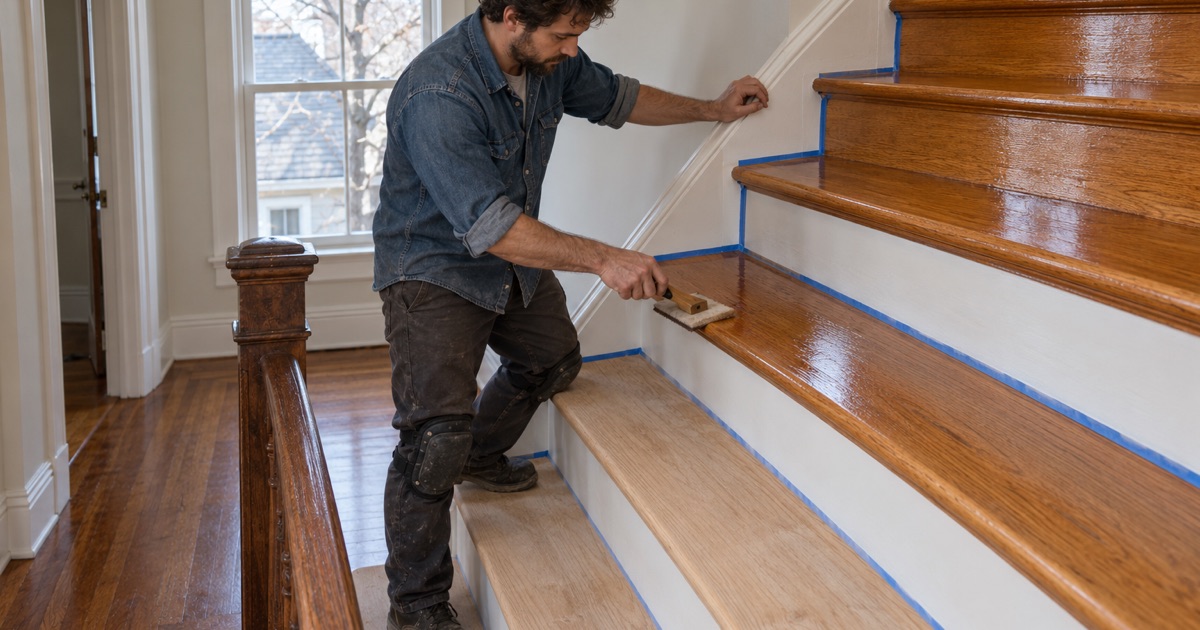
The stair treads are the horizontal steps you walk on, the stair risers are the vertical faces between them, and the stair nosing is the rounded front edge of each tread. Each takes wear differently: treads wear in the center, nosings wear and chip at the edge, and risers collect scuffs from shoes.
We treat each part on its own terms. Treads are sanded back to clean wood, nosings are shaped and smoothed by hand, and risers are either refinished to match or painted, depending on the look you want and what is underneath.
Why Stairs Are Quoted Tread by Tread
A flight of thirteen stairs might cover less area than a small bedroom, yet it can take longer to refinish than the bedroom does. The time goes into edges, corners, nosings and the spaces between balusters, none of which a large floor sander can reach.
Quoting tread by tread keeps the price honest. You can see exactly what each part costs, compare it with the floors, and decide, for example, whether to refinish the risers or paint them.
Landings and Where Stairs Meet Floors
Landings are small floors in their own right, and the transition where the bottom step meets the hall floor is where color differences show most. We plan the stairs and landings with the floors around them so the staircase looks like part of the house, not an addition.
If the floors are being refinished at the same time, the stairs are scheduled in the same sequence so stain and finish match. If not, we test color against the existing floor before committing.
Painted and Carpeted Stairs
Lead Checks on Painted Stairs
Painted stairs are common in older houses, and in a home built before 1978 that paint may contain lead. Massachusetts runs its own lead-safe renovation rules for that housing, and sanding painted treads or risers is exactly the kind of work they cover.
We confirm the build year and check the paint before any sanding. Where lead paint is present, it is dealt with under those rules before the stair work continues, so the dust from a refinish never becomes a lead hazard in the house.
Taking Painted Treads Back to Wood
Once the paint question is settled, painted hardwood treads can usually be taken back to bare wood and refinished. Paint fills the grain and the gaps at the edges, so the stripping and sanding are slow, careful work.
Risers are a different decision. Many owners keep painted risers, which give a crisp contrast with stained treads and avoid stripping paint from a surface nobody walks on. We price both options so you can choose.
Carpeted Stairs Brought Back to Wood
Under stair carpet, there is sometimes a finished hardwood staircase in good shape, and sometimes rough treads that were never meant to be seen. The first thing we do is lift a corner and look.
Finished treads are cleared of staples, tack strip and carpet pad residue, then refinished. Rough treads can be covered with new hardwood stair treads and risers cut to fit each step, which gives a finished staircase without rebuilding the structure underneath.
Our Step-by-Step Stair Refinishing Process
1. Inspect and Quote
We count the treads, risers and landings, check for paint and its age, look for loose or cracked treads, and test what finish is on the wood. The quote lists each part, so nothing is hidden in a lump sum.
If the floors are being refinished too, the stairs are quoted alongside them but as their own line. That makes it easy to do the stairs now and the floors later, or the other way round, without the price shifting.
2. Repairs First
Loose treads are refastened or glued, creaks are traced to the tread, riser or stringer causing them, and cracked or broken nosings are repaired or replaced. Fixing them before sanding means the repair disappears under the new finish instead of being done afterward.
Where the underside of the staircase is open from a basement, we make most repairs from below, which leaves no fastener heads in the treads. Otherwise, fasteners are set and filled before sanding so they vanish under the finish.
3. Hand Sanding and Detail Work
Each tread is sanded with smaller machines, and the corners, nosings and edges along the skirt board and balusters are scraped and sanded by hand. Dust is collected at the machine with HEPA-filtered vacuums, which matters on a staircase because dust travels up and down it into the rest of the house.
4. Stain and Finish
If you want stain, we test it on a tread first. The finish goes on in thin coats, and on many staircases we coat alternate treads so the household can still use the stairs while the first set dries. The remaining treads are finished once the first set can take light foot traffic.
Making Stairs That Last
Matching Stairs to Refinished Floors
When the floors and stairs are the same species, they can take the same stain and finish and read as one continuous surface. When they differ, as when oak stairs meet a maple or pine floor, the same stain can look very different on each. We lay stain samples on both before committing, so you see the match, or the deliberate contrast, before the color goes on.
Choosing a Finish for Heavy Traffic
Stairs take concentrated wear at the center of each tread and the nosing. A durable polyurethane in a satin or matte sheen hides wear and is less slippery underfoot than gloss, and some finishes can carry an anti-slip additive in the final coat.
If you plan to add a stair runner, we leave the treads finished and ready for it. The exposed edges then stay protected while the runner takes the worst of the wear.
New Treads Where the Old Ones Are Gone
Some treads are too worn, split or patched to refinish well. Those are replaced with new hardwood treads cut to fit the step, because older staircases are rarely square and a stock tread rarely fits without work. New treads are finished to match the rest of the staircase, so the replacement steps do not stand out.
- 20+ Years on Wood Floors
- Stairs Quoted Tread by Tread
- Lead Checks Before Sanding